
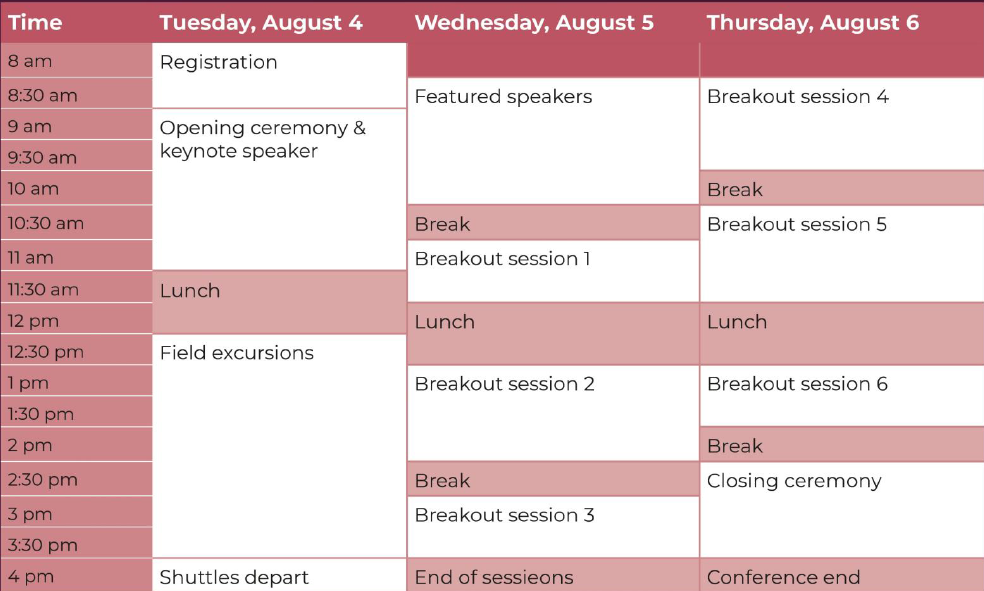
Breakout Session Schedule
August 5 - Wednesday
11:00am - 12:00pm
Community Clean Energy Education
Adriana Northcutt, Ana McMenamin
Elizabeth Peratrovich Hall Room 1 - Hybrid/Education
Poetry for Connection: Writing About Place & Self
Lorena Germán, Roberto Germán
Elizabeth Peratrovich Hall Room 2 - Education
Participants will learn about using poetry to help students make connections to their communities (place) and their identities (self). Grounded in culturally sustaining pedagogies, the session will offer examples and theory for foundational understanding of the impact of such work. They will use poetry from Blue Ink Tears (Germán, 2023) as a mentor text in order to identify strategies for immediate classroom use. Participants will also receive a “Teaching Guide for Blue Ink Tears.”
Supporting Culturally Responsive Literacy with Native Ways of Knowing Literacy Resources
Dr. Staci Block
Elizabeth Peratrovich Hall Room 3 - Education
This session introduces the Native Ways of Knowing Literacy Resources, designed to support educators and librarians in selecting and teaching high-quality, culturally responsive literature. Participants will explore research-based literacy strategies that foster decolonized and indigenized learning environments for K–12 American Indian and Alaska Native students.
Educators and families will gain tools to identify and incorporate Indigenous-authored books that offer authentic insights into Native cultures, storytelling traditions, and tribal languages. Participants will learn how to expand their collections with works that honor cultural sovereignty and promote empathy, resilience, and deeper understanding among all students.
Grounded in the work of scholars such as Reese, Fryberg, Sabzalian, and Pewewardy, this session provides strategies for culturally and linguistically responsive instruction that supports Indigenous learners. Educators will explore ways to create inclusive classrooms and libraries that reflect Native Ways of Knowing and literacy practices.
Led by Native educators, cultural leaders, and tribal experts, the training empowers participants to advocate for Indigenous education and cultural preservation. Attendees will gain practical tools, including Native read-aloud strategies, Indigenized lesson plans, award-winning book lists, place-based learning activities, and Indigenous author and illustrator webinar recordings.
The Way You Do the Work Is the Work: Humor and Relationality in Research Collaboration
Sara Little
Walter Soboleff Building Clan House - Education
How can collaboration change the way we understand science, relationships, and responsibility? Western science often prioritizes technical tools and neutrality; undervaluing relational skills. As climate change intensifies the need for partnership, we’re learning how humor can make a difference in collaborations with multidisciplinary and multicultural teams; laughing together through honest moments of misstep and informal teaching opportunities that foster mutual understanding and reflexivity.
From the perspective of a student and settler, Sara Little critically reflects on experiences working in Alaska, including work with Sealaska Heritage Institute, and current master’s research at Western Washington University through the Active Societal Participation in Research and Education (ASPIRE) team. ASPIRE brings together social scientists, geoscientists, and communities working toward more equitable, ethical, and culturally responsive approaches to science.
In this session, we will share experiences and reflections on labor imbalances and settler responsibilities in research and education. Participants will leave with practical reflections on how humor, humility, and sharing vulnerable moments can support more relational understanding and change the lens through which science is viewed.
Intermediate Tlingit Asynchronous Course on Transparent Language
Anna Clock
Sealaska Corp Room - Language
Young and adult learners can practice the Tlingit language free online with interactive visual and audio features through the Transparent Language software. Sealaska Heritage recently published their intermediate course, available to the public. This level of the course challenges learners to understand and respond to prompts about cultural activities featured in posters for four months out of the year. So far, the intermediate course has been assigned to public school students whose Tlingit language teacher was on work travel, new teachers and parents in the Tlingit Culture, Language, and Literacy (TCLL) program, and other learners who want to continue practicing between classes. The author of the course will share an example lesson and answer any questions about making a course of your own.
The Need to Bead
Whitney Staub
Sealaska Heritage Art Campus Weaving Room - Arts
In this session, we will discuss the historical progression of beadwork. Participants will have the opportunity to see different styles and types of beadwork. The main focus of this presentation will be discussing the importance of reviving beadwork in schools and the significance of beading graduation caps. Participants will have the opportunity to set a loom and bead a small loom piece. Teaching underclassmen the importance of incorporating their culture into their academic studies is crucial in building confidence and resiliency in our youth.
We Wear Kicks: Using Cultural Identity to Build Leadership and Belonging in Education
Leonard A Williams
Sealaska Heritage Art Campus Metal Room - Education
In education, culture is often treated as something to acknowledge rather than something to leverage. Yet our identities, stories, traditions, and lived experiences are among the most powerful leadership tools we possess. This interactive session explores how cultural identity can be used to strengthen leadership, foster belonging, and create environments where students, educators, and communities thrive.
Using personal storytelling, leadership frameworks, and lessons drawn from popular culture, Leonard A. Williams challenges participants to rethink what leadership looks like in modern educational spaces. Attendees will explore how authenticity builds trust, how representation shapes engagement, and how culturally responsive leadership can transform school and campus communities.
Participants will leave with practical strategies to create stronger connections, increase belonging, and empower others to lead without leaving parts of themselves behind. Because when people feel seen, valued, and connected to their culture, they don't just participate—they lead.
Teaching Science in Place: Bridging Indigenous Knowledge and Western Science in Southeast Alaska
Wendy Todd
SHI Indigenous Science Building Kitchen - Education
We will explore place-based approaches to STEAM education that bridge Indigenous Knowledge systems and STEM to create meaningful, culturally responsive, and community-centered learning experiences. Drawing from work with Alaska Native communities, educators, Elders, and students across Southeast Alaska, the presentation will highlight how local lands, waters, languages, stories, and traditional practices serve as powerful contexts for teaching STEAM . In this session we will explore Indigenous science concepts, experiential learning, ethnostory and analysis, Traditional Knowledge, language, cultural values, ethics, and tribal partnerships into STEAM instruction. The presentation will examine how bridging knowledge systems supports student engagement, identity development, environmental guardianship, and deeper understanding of complex social-ecological systems. Participants will explore practical strategies for creating inclusive science learning environments that honor multiple ways of knowing while strengthening connections between education, culture, and place.
Coding With Culture: From Learners to Builders
Nathan Bennett
SHI Indigenous Science Building Classroom - Innovation (STEAM)
Coding With Culture explores how Indigenous youth and community members can move from simply using technology to building technology shaped by their own languages, stories, and values. This session will introduce practical ways beginner-friendly coding tools and AI-assisted development can help create small apps for language learning, pronunciation practice, storytelling, cultural education, mapping, and digital stewardship.
The focus is not on replacing Elders, teachers, linguists, or cultural authorities. Instead, this session shows how technology can support their work when it is guided by community permission, review, consent, and responsibility. Participants will see examples of culture-centered digital tools connected to Future Ancestors Alliance’s work, including youth tech cohorts, Indigenous language apps, language recordings, learning games, and community-controlled data systems.
This session is designed for educators, youth, language learners, cultural program staff, and community members who are curious about how technology can serve our communities when we build it ourselves. Participants will leave with a clearer understanding of how Indigenous communities can use modern tools while keeping culture, language, and community authority at the center.
1:00pm - 2:30pm
Braiding Ways of Knowing: Transforming Education through Indigenous Epistemology
Dr. Agatha John-Shields, Angela Koogak’aax Lunda, Bethany Ulroan, Nasgauk Paula Jones, Naucetaaq Valerie Svancara
Elizabeth Peratrovich Hall Room 1 - Hybrid/Education
Indigenizing education involves a fundamental shift in the relational and structural landscape of the classroom. This presentation explores a transformative framework for education that prioritizes Indigenous ways of knowing, being, and doing. By moving away from Eurocentric, individualistic models, we can create learning environments that honor the whole person and the community. To explore this shift in practice, this session brings together two University of Alaska School of Education professors who designed a pioneering graduate certificate program in Indigenizing Education, alongside two students from the inaugural cohort. Together, the panel will unpack the practicalities of the Wholistic Approach, the challenges of centering Indigenous epistemologies within traditional institutions, and the power of building on cultural values as a foundation. By sharing the journey of this certificate program, the presenters will demonstrate how faculty and students can co-create knowledge and move toward a future where educational settings benefit all learners and educators, as guided by Indigenous knowledge, perspectives, and practices.
Coastal Storytelling and Promoting Elder Engagement in the Classroom
Doreen Hayward, Hana’ackm Ggoadm ‘Tsoal / Naomi Leask, Melody Leask
Elizabeth Peratrovich Hall Room 2 - Education
The aim of this presentation is to impress on K–12 teachers, researchers, and others the value of Indigenous storytelling and shared local coastal knowledge. A Ts'msyen Elder and a culture bearer from Metlakatla will provide in-person storytelling and a short video entitled "Dooyks ada Aks" will showcase local Metlakatla community members sharing their knowledge of currents and tides. Ocean safety and resources harvested from the ocean are emphasized in the video. Sm’algyax language terms introduced in the video will be reiterated in online resources including activities and a pronunciation guide. Participants will learn appropriate ways to respectfully invite local Elders into the classroom to engage with students. Through the Cultural Connections to Alaska Science program, Metlakatla was one of four participating communities to co-produce educational resources for high-school students. The Cultural Connections Process Model used to develop resources can equip teachers to incorporate local knowledge, priorities, culture, and Native language in teaching.
Tools for Learning and Healing Across Cultures
Sadie Olsen, Travis Tennessen, Caydden James Gordon-Baker, Dominique Jerome Casimir
Elizabeth Peratrovich Hall Room 3 - Education
Workshop attendees will learn and practice with social learning tools that facilitate cross-cultural learning and healing. Indigenous-led Whiteswan Environmental (WE) and the Western Washington University Center for Community Learning co-convene the Nexw Xwelemi Tengexw (Territory of the Lummi people) Gen cohort of the Community Engagement Fellows program (cefellows.org), which brings together Indigenous and non-Indigenous community members for intergenerational learning, healing, and exploring potential collaborations that support ecological and cultural restoration in the Salish Sea Region. Through that work, we’ve co-developed tools that are culturally inclusive and which foster rich reflection, thoughtful listening, and creative solutions. The workshop will primarily focus on demonstrating and practicing with two of those tools – dual language Talk Tiles and Design Clinics. Talk Tiles are a language-learning and reflection tool including eight colorful dominos, each with a word/phrase that relates to a dimension of learning. Design Clinics are a structured brainstorming method that mobilizes collective wisdom in an equitable, culturally inclusive way through engaging with a group members’ challenge. Together we will learn Xwelemi Chosen words/phrases used for Talk Tiles and practice several ways to use them, and practice a design clinic focused on the culturally responsive educational work of a group member.
The Ladder of Prejudice: From Name Calling to Genocide
Gertrude Joan Noden
Walter Soboleff Building Clan House - Education
In his book The Nature of Prejudice, Gordon W. Allport uses the metaphor of a ladder to describe how “little acts,” which often go unnoticed, can lead to more serious and disruptive individual and collective behaviors.
This framework describes, in ascending order, five “rungs” of intolerance and injustice: speech, avoidance, discrimination, physical attack, extermination.
This is an interactive, full participation workshop facilitating conversations to identify and apply the “rungs” as evidenced in our world, historically through present day. Evaluation of primary source documents and current events will be analyzed to identify real challenges facing present-day society.
Strategies for facilitating safe discussions about negative assumptions and inappropriate behaviors based on prejudice and ignorance will be explored. Participants will be challenged to identify ways to restore tolerance in themselves, and our everyday lives.
One component of the Ladder of Prejudice workshop is guided practice with participants facilitating safe conversations of our own negative personal biases and prejudices. The purpose is to engage reevaluation of our own commitment to respect and tolerance. Hands-on activities will result in an art installation representing the metaphor of Ladder of Prejudice, From Name Calling to Genocide.
Teaching With the Land: Learning Through Tlingit Seasonal Knowledge and Cultural Responsibility
Levi Rinehart
Sealaska Corp Room - Education
Grounded in the theme “Learning from Our Ancestors, Shaping Our Future,” this session invites educators to explore how Tlingit seasonal knowledge systems can serve as a living framework for culturally responsive education. Drawing from experience in Tlingit and Haida’s Haa Yoo X̱’atángi Kúdi Tlingit language immersion preschool, the presenter will share how seasonal cycles such as herring spawn, berry harvesting, salmon processing, and winter storytelling reflect deeply rooted values of respect, reciprocity, observation, and responsibility.
Participants will examine how land, season, and relationship can guide curriculum design in ways that move beyond surface-level cultural inclusion toward meaningful integration of Indigenous knowledge and language. The session will also address the importance of cultural responsibility, including building authentic relationships with Native communities and respecting community knowledge, protocols, and land.
Through storytelling, practical examples, reflection, and interactive engagement, participants will leave with concrete ideas for implementing land-based and place-based learning in their own classrooms while supporting the cultural vitality of future generations.
Busy Hands, Big Conversations: Creativity as a Talking Tool
Chookán (Lakrisha) Brady
Sealaska Heritage Art Campus Weaving Room - Education
Participants will experience a Busy Hands, Big Conversations model, and then break down the methods and tools used. This model was created and adapted with the understanding that creating something alongside others can be a useful tool when having conversations with families, schools, and communities. The Busy Hands, Big Conversations model should be adapted for each school and community's needs, but participants will experience one adaptation of this model, and will leave with a better understanding of what this can look like in their communities.
Forgiveness Education: Healing the Hurt - Honoring Past and Future Generations
Judith Ann Korn, Serena Cisneros
Sealaska Heritage Art Campus Metal Room - Education
Ancestral knowledge and experiences are passed to future generations through shared stories, cultural traditions, and collective memory. Similarly, trauma endured across generations can influence epigenetic mechanisms that affect patterns of gene expression, contributing to intergenerational trauma. As Anishinaabe knowledge keeper James Vukelich Kaagegaabaw explains, this can mean “inheriting pain that is not our own.”
One powerful tool that can support resilience in the face of past and future hurt is forgiveness. Forgiveness education has been shown to significantly reduce anger, an emotional state associated with increased risk for anxiety and depression. Forgiveness does not equate to pardon, reconciliation, or forgoing the pursuit of justice and can be embedded into school curricula through storytelling, guided discussions, and activities that cultivate perspective-taking and empathy.
Forgiveness is medicine, it fosters hope and healing and in the words of the late Rita Blumenstein, “When we heal ourselves, we also heal our ancestors, our grandmothers, our grandfathers, and our children.”
Traditional Futures: Using Indigenous Culture in Fantasy, Sci-Fi, and Other Forms of Fiction
Christopher Caskey Russell
SHI Indigenous Science Building Kitchen - Arts
This presentation will explore the potentials, pitfalls, and ethics of using Indigenous culture as the inspiration for speculative fiction (fantasy, sci-fi, horror, alternative history, magical realism). The basis for the presentation will be Russell’s Tlingit inspired fantasy novel The Door on the Sea, and include discussion of the joys and challenges of writing and publishing an Indigenous-inspired fantasy novel.
Culturally Responsive Frameworks for Literacy & Numeracy
Dr. Cassie L. Raye, Patricia Johnson
SHI Indigenous Science Building Classroom - Education
A culturally responsive literacy and numeracy framework grounded in an Indigenous perspective recognizes that learning is relational, holistic, and connected to identity, culture, language, and community. The framework honors Indigenous ways of knowing by integrating storytelling, oral language, land-based learning, and cultural knowledge alongside evidence-based literacy and numeracy practices. It supports students in seeing themselves reflected in their learning while building strong foundational skills in reading, writing, mathematics, and problem-solving. By valuing diverse perspectives and experiences, the framework promotes educational equity, strengthens student engagement, and fosters a sense of belonging and success for all learners.
3:00pm - 4:00pm
Curriculum as Ceremony
Kapela Eli, Courtney Perreira, Kaailee Pacatang, Kalehua Kamohoaliʻi Caceres
Elizabeth Peratrovich Hall Room 1 - Hybrid/Education
Wahi a kūpuna, “Ua lehulehu a manomano ka ʻikena a ka Hawai’i.” “Great and numerous is the knowledge of the Hawaiian people.” This popular ʻōlelo noʻeau or proverb has been applied in many cultural practices and educational programs throughout Hawai’i as an assurance that ancestral knowledge is a firm pathway towards education, enlightenment and empowerment as Native people.
The INPEACE Keiki Steps program is grounded in ancestral knowledge systems that view children as whole beings—connected to culture, language, ʻohana (family), and ʻāina (land). This presentation explores how ceremony and ritual function as daily learning practices, supporting inquiry-based exploration while reinforcing cultural identity, language, and relational responsibility. Rather than positioning culture as enrichment, Keiki Steps centers on ancestral practices as the foundation for innovation, curiosity, and collective learning.
Participants will engage with examples of how Keiki Steps weaves oli, pule, hoʻokupu, cultural protocols, and reflective practices into everyday learning experiences—creating environments where keiki, families, educators, and community partners thrive together. The session demonstrates how these practices embody the principles of culturally responsive education while addressing contemporary challenges facing Native communities.
Story, Kinship, Belonging: Three Native Authors on Cultural Representation in Children’s Literature
Christine Hartman Derr, Karina Iceberg, Kaukanilehua Māhoe Adams
Elizabeth Peratrovich Hall Room 2 - Arts
Three authors from the Alaska Native, Native Hawaiian, and mainland Native American (Cherokee Nation) communities will discuss how kinship and belonging are woven into their storytelling via contemporary Native characters. These stories have an impact on the greater community, inviting readers to learn and grow with characters like themselves. Topics of discussion will include Native language revitalization, mental health outcomes, the power of intergenerational community, and how connection is the basis for belonging and ultimately healing. The authors will be providing specific examples from their own titles, including Karina Iceberg’s Free to Fly and A Good Hide, Kauakanilehua Māhoe Adams’ An Expanse of Blue and We Are Hapa (forthcoming), and Christine Hartman Derr’s Raven, Rising and Until We Meet Again: Donadagohvi (forthcoming). The heartbeat of this presentation is the power of representation, both on the page and in living communities; this foundation rests upon ancestral and Elder connections, connections that are crucial to community and individual healing. Woven throughout the presentation is a much needed celebration of the ever-growing body of Native-authored work, especially in the field of children’s literature. Good representation is full representation, acknowledging the hardships while celebrating strong communal and cultural ways.
Seeds of Native Knowledge: Culturally Sustaining Teaching
Dr. Staci Block
Elizabeth Peratrovich Hall Room 3 - Education
This session provides resources from the Seeds of Native Knowledge: Culturally Sustaining Teaching Institute, a collaborative initiative designed to support educators, administrators, tribal education staff, and community partners in strengthening culturally responsive and sustaining teaching practices. Rooted in the theme of Seeds of Native Knowledge, this session highlights how education can plant and nurture pathways toward truth-telling, cultural understanding, and equity for both Native and non-Native students.
Participants will explore frameworks that honor the educational sovereignty of Native Nations while advancing authentic, place-based, and community-centered learning environments. The session provides an overview of the California Native American Studies Model Curriculum (NASMC), Essential Understandings of Native American history and culture, and interdisciplinary approaches to Indigenous mathematics and literacy integration. Participants will also gain tools to identify and incorporate Indigenous-authored texts that reflect Native cultures, storytelling traditions, and tribal languages.
Grounded in the work of scholars such as Reese, Fryberg, Sabzalian, and Pewewardy, this session highlights strategies for culturally and linguistically responsive instruction that supports Indigenous learners. Educators will explore ways to create inclusive classrooms that reflect Native Ways of Knowing and literacy practices. Led by a Native educator and curriculum writer, the session empowers participants to advocate for Indigenous education and cultural preservation.
Footprints of Our Ancestors: A Pathway for Indigenous Mapping By Us, For Us
Amelia Wilson, Ghagetch Rebekah Sawers, Kaasteen Sonya Johnson, Sei ya' eesh Jeff Skaflestad
Walter Soboleff Building Clan House - Education
Like many Indigenous communities, for our village of Hoonah, our history is inextricably interwoven with the water and the land, yet the details of our settlement history following the forced migration from our homeland of Glacier Bay remained scattered knowledge. Through our IMLS-funded project "Perpetuating Our Culture Through Placenames," the Huna Heritage Foundation created a visual nexus of history, movement and connection. This session is specifically designed for representatives from Native villages or Indigenous organizations who wish to transform their community’s histories into tangible visual educational tools.
We will provide a behind-the-scenes look at our project's lifecycle, from securing federal funding to collaborating with landscape architects like Corvus Design to create our physical wall map. Participants will learn how archival audio and video and new interviews can be used to bring forward the voices of ancestors, Elders, and culture bearers, ensuring that our maps are not just geographic grids, but living records of our Tlingit identity. We will share our mitigation plan for cultural accuracy. Attendees will leave with a practical framework for identifying unmapped locations, managing digital media, and creating meaningful learning tools and resources to enhance local school curricula to ensure our culture is perpetuated for future generations.
Developing a Regional Language Strategic Plan: Examples from Bristol Bay
Marissa Naanaaruaq Vinberg, Montana Murphy
Sealaska Corp Room - Language
For many Indigenous communities, the idea of language reclamation is nebulous, and determining how to approach this work can be an intimidating process. Where and how does a community start or continue language education? In this session, we will explore how the Bristol Bay Foundation partnered with Raven’s Group to develop a strategic plan encompassing our three regional languages: Alutiiq, Dena’ina, and Yup’ik. The Bristol Bay Indigenous Language Strategic Plan, finalized in spring 2026, draws input from a variety of collaborative spaces with in-region organizations and community members to ensure the plan addresses region-specific needs across family, community, education, and policy domains. Development of the plan was supported by Building Up Bristol Bay Language Education, an Alaska Native Education Program grant, and the efforts of our language speakers, Elders, teachers, and learners.
Sayummaktuq: It is Energized-A Curriculum about Energy in the Northwest Arctic
Lori Schoening, Ricky Ashby / Qaaġagliq, James Johnson III
Sealaska Heritage Art Campus Weaving Room - Education
The Sayummaktuq: It is Energized curriculum was developed as part of the University of Alaska Fairbanks Geophysical Institute’s Cultural Connections to Alaska Science project, using a co-production model that brings researchers and curriculum developers together with Indigenous communities to develop science curricula on community-driven themes. A team of Iñupiaq knowledge bearers from the Kotzebue region identified energy as an essential theme for students in their region to learn about. In the Arctic, monthly home energy costs can exceed mortgage or rent.
The community team guided content development for this place-based and culturally grounded high school unit. It is designed to help students learn how their community relies upon renewable and non-renewable energy today and in the past, as well as energy conservation strategies applicable to Alaska, and how renewable resources are converted to electricity. Local Elders and community members, local industry professionals, and university scientists all contributed to and are highlighted in the finished products.
This session will explore the free resources and overview the co-production model used to develop them. Participants will practice Iñupiaq terminology related to energy, try hands-on lessons, view a film rich with Elder interviews, and discuss how the resources could be adapted for use in their classroom or community.
Fostering Healthy and Regulated Classroom Environments
Jordann Lankford
Sealaska Heritage Art Campus Metal Room - Education
This session will explore how educators can foster healthy, regulated classroom environments by understanding the impacts of generational trauma on student learning and behavior. Participants will examine strategies that support the physical, social, and emotional needs of Native American students while empowering youth to thrive in school settings. The session will also highlight the importance of building strong relationships between schools, families, tribes, and communities to create a foundation of trust and support. Attendees will leave with practical approaches to strengthen student resilience, perseverance, and overall classroom well-being.
Shaping the Future of Indigenous Studies at an Alaska Native-Serving University
Polly Hyslop, Beth Leonard
SHI Indigenous Science Building Kitchen - Education
Alaska Pacific University is an Alaska Native-serving institution currently on a path toward tribal university status. An Indigenous Studies BA is in the final approvals process. Presenters in this session will discuss the history of the proposed BA, and solicit feedback from the participants/audience through a series of questions including:
- What is your perspective on the future of Indigenous Studies programs in universities?
- Are there specific technical or leadership skills that are most needed in Native communities in Alaska e.g., peacemaking, grant writing, tribal governance, or land stewardship?
- What have been the major challenges for university students in terms of access and degree completion?
Growing Hope & Belonging: Learning from Our Ancestors to Shape Relational Futures
Tammy Lynn Iund
SHI Indigenous Science Building Classroom - Eduation
This interactive session explores how storytelling, relationships, and community values help cultivate belonging and hope in today’s educational and community spaces. Grounded in both lived experience and professional practice, the presenter reflects on lessons passed down from her grandfather, grandmother, and father—storytellers who taught that family means loving fiercely, even in disagreement, and making space for others with kindness, grace, and accountability.
Participants will engage in reflection, dialogue, and collaborative activities that connect these teachings to practical strategies for supporting youth, families, and communities. The session weaves Indigenous values together with relationship-centered practices and the science of hope, offering accessible tools that can be applied across educational, family, and community settings.
Honoring the understanding that while much has been taken from Indigenous communities, what remains is powerful, this session invites participants to move beyond deficit-based thinking and toward practices rooted in connection, inclusion, identity, and shared humanity. Attendees will leave with practical ideas for intentionally creating spaces where people feel seen, valued, and connected.
August 6 - Thursday
8:30am - 10:00am
Writing Story Workshop with Keynote Speaker Ernestine Hayes
Ernestine Hayes
Elizabeth Peratrovich Hall Room 1 - Hybrid/Education
In workshop format, participants in this breakout session respond to and share writing prompts, considering elements of craft, discussing examples from published works, and exploring the relationship between personal perspective and cultural memory.
Haa Latseení–Strength of Body, Mind, and Spirit: Lessons of the past made into practice in classrooms and at home
Lisa X’unyéil Worl, Maressa Alrich
Elizabeth Peratrovich Hall Room 2 - Education
Join us to hear and see how we're helping build educator and family capacity to understand co-regulation, essential social-emotional strategies, and tools. We'll share how many of the co-regulation tools and strategies reflect many of the same ways of being and incorporate our value of Haa Latseení. We'll share training highlights and the vital role self-care plays in helping their child, and themselves, thrive using the Association of Alaska School Boards’ Stronger Together Framework. We'll model activities and practices that you can incorporate into your classroom in a culturally responsive way.
From Battleship to Canoe: Restructuring School Governance Away from Hierarchy and Toward Clan-Based Decision-Making
Stacey Skan
Elizabeth Peratrovich Hall Room 3 - Education
Most education reform focuses inside the classroom. But what if the most damaging bottleneck sits at the very top? The school board. The superintendent. The elected officials who may have no organizational management background. This session applies organizational management principles to diagnose how hierarchical governance structures—specifically the elected, top-down school board model—systematically slow decision flow and undermine learning. Using the Tlingit and Haida matrilineal clan system as a working precedent, we will explore what distributed, non-hierarchical governance actually looked like: decisions made at the waterline, accountability visible through the potlatch, and authority inherited through maternal lines rather than elections.
More importantly, this session maps the actual policy room available under state and federal law. Do you have to keep your school board on top? Can you change qualifying factors for board membership? Can a tribal compact school replace its board entirely with a clan council? Where state law sets a floor, what ceiling exists above it?
Attendees will leave with a specific policy checklist: where their state code is silent (and therefore flexible), where federal law permits tribal governance alternatives, and how to begin restructuring away from hierarchy without first changing every law on the books.
Using Digital Storytelling to share Indigenous Knowledge
James Johnson III, Lynda McGilvary
Walter Soboleff Building Clan House - Education
UAF’s Geophysical Institute Education Outreach team members will showcase three short films from the Cultural Connections to Alaska Science project: Medicinal Plants, Water is Life, and Salmon. Medicinal Plants was co-created with the Fort Yukon community, Water is Life was co-created with the Metlakatla community, and the Salmon video was co-created with statewide partners. A total of ten videos were produced in this education series. Each video tackles a topic deemed by local community members to be relevant to each region and its residents. These videos are short-documentary, interview-driven resources that focus on local priorities and build upon the science themes illustrated in the curricular series.
After screening the videos, participants will discuss the use of digital storytelling in the classroom and highlight its purpose as a powerful medium for teaching K–12 students. Topics will include: building trust with community partners, decision-making led by community advisory teams, and filming, producing, and vision for the videos.
Haida language stories and Learning X̱aad Kíl
Dr. Jasḵwaan Bedard-X̱aad Kíl Gyáahlaangee
Sealaska Corp Room - Language
The role of gyáahlaangee, stories, are of great importance for teaching and strengthening X̱aad Kíl, the Northern dialect of the Haida language. This presentation outlines how elements of X̱aad Kíl Gyáahlaangee are used as learning tools for an intermediate cohort of X̱aad Kíl students through Simon Fraser University’s Indigenous Languages Program Haida Language Storytelling classes. This presentation will outline the process of creating course material by studying our ancient gyáahlaangee - stories, and the learning outcomes experienced by students as a result of learning through story.
Weaving Culture and Learning: Arts Education Grounded in Community
Misty Holler, Spiridon Gguitka Ash
Sealaska Heritage Art Campus Weaving Room - Education
This session invites participants into a culturally responsive, arts-integrated experience led by Sperry Ash and Misty Holler. Through the creation of an “I Am From” poem, participants will engage in guided reflection to explore personal identity, deepen empathy, and connect lived experiences to classroom practice. Grounded in community and culture, this session models how storytelling and the arts can serve as powerful tools for student voice and belonging.
Presenters will also share their experiences implementing culturally responsive practices through their work with the Alaska Arts Education Consortium, highlighting programs and opportunities that support educators in integrating arts, culture, and community into meaningful learning experiences across Alaska. Participants will leave with a practical strategy, a personal artifact, and inspiration to elevate every voice in their learning spaces.
Identity, Community, & Purpose: Supporting Indigenous Youth in a Western Education System
Krista Pitsch, Sara Battiest, Scott Pitsch, Shannon Dodge
Sealaska Heritage Art Campus Metal Room - Education
The Tinitun (Dena'ina word meaning "Pathway") College and Career Readiness Center is an initiative within the Education Department of the Kenaitze Indian Tribe. Tinitun is staffed with three advisors who specialize in Indigenous teacher prep, college prep, or CTE prep. During this workshop, we will explore the services we provide to both middle and high school students, as well as the paid apprenticeship opportunity for juniors and seniors.
Alaska Plant Teachings for Wellness
Naomi Michalsen, Miakah Nix
SHI Indigenous Science Building Kitchen & Classroom - Education
In his interactive workshop participants will explore plant teachings and social-emotional skills, experience hands-on wild foods and medicine making, storytelling, games and other activities. Naomi and Miakah will share ways to adapt the curriculum to a variety of learning environments including education, behavioral health, food sovereignty, and wellness programs. Participants will be introduced to the plant teachings kit (book, plant cards, activity guide, posters, infographics, videos and recipes). Space is limited to 15 participants.
The Indigenous based curriculum, Alaska Plant Teachings, was inspired by many Elders, cultural teachers and Pacific Northwest Coast tribal communities. Ancestral knowledge and values guide the content, which are direct teaching tools for education, prevention, intervention and healing for our communities. Taking time to learn together while honoring the past helps us with much needed daily strategies for becoming our true selves today.
10:30am - 12:00pm
Stronger Together: Honoring Identity and Belonging for Multiracial Indigenous Children
Dr. Katie Idalia Archer Olson
Elizabeth Peratrovich Hall Room 1 - Hybrid/Education
Boricua inspired by the call for unity, reminding us we are stronger together, this interactive session explores how Alaska educators can honor and affirm the identities of multiracial Indigenous children. Too often, children whose identities span multiple cultures, tribes, or languages encounter subtle forms of exclusion such as colorism, questions of authenticity, or expectations that they must be “fully” one thing to belong. These messages can undermine children’s confidence and sense of place within their own communities.
This session centers on the belief that loving and teaching the whole child, including their layered histories, families, languages, and cultural connections, empowers young learners to see themselves as capable, valued, and connected to both ancestors and future possibilities. Participants will explore how multiracial Indigenous children bring powerful strengths to classrooms and communities, including diverse cultural perspectives, adaptability, and the ability to navigate multiple worlds.
Through discussion and reflection, educators will examine strategies for creating identity-affirming early childhood environments that nurture belonging and pride. Participants will also engage in a hands-on activity to design a classroom identity storybook, a tool children can use to celebrate their heritage, families, and dreams.
Indigenizing Education Across Cultures
Dr. Agatha John-Shields, Dr. Dawn Hardison-Stevens
Elizabeth Peratrovich Hall Room 2 - Education
Important work needed in Indian Country is collaboration among the few Native peoples as they cross cultures and respective higher education programs. Indigenous people need the academic system as much as the educational system needs Indigenous people. As first-generation higher-education learners, families' journeys came together as their fathers influenced Indigenous people to pursue doctoral degree pathways. Collaboration among Native peoples in higher education is essential for addressing the needs of Indigenous communities. Necessary partnerships emphasize integrating this knowledge through holistic teaching methods, which are vital for first-generation learners influenced by their families' traditional upbringing. Our ancestral stories guide our teaching and contribute to meaningful educational change from pre-kindergarten to college. Cultural awareness, expressed through ancestral storytelling, is a key theme. Tools like the Sacred Circle, Qungasvik (The Toolkit), and Calricaraq (Wellness) Wheel, used for self-assessment, have shown that Indigenous and non-Indigenous students have reported benefits from these approaches and have found greater well-being through their use. As we honor our Elders, their wisdom guides younger people toward greater awareness, holistic wellness, and healing. By integrating Native knowledge into educational practices, the goals aim to achieve systemic changes that will benefit learners and future generations
Rethinking Museum Work for Community and Culturally Responsive Collaboration
Dawn Biddison, Melissa Nenantaxnen Shaginoff, Noëlle Marty
Elizabeth Peratrovich Hall Room 3 - Education
When community members connect with ancestral items in museum collections, staff can support work that increases Indigenous voices in educational experiences and resources for museum and classrooms. In this session, staff from the Smithsonian and Anchorage Museum will share three core values based on the interrelated potential of community members with museum collections, the roles of museum staff, and opportunities for educators; all aiming to increase Indigenous knowledge in education. Presenters will provide examples of implementing these values in projects, along with resources available in person and for free online. A facilitated brainstorming session will support participants in utilizing museum resources for their work from any location.
Let’s Chat!: the Inclusion of Conversational Alaska Native Translation in Co-produced Science Curriculum
Mariah McNamara, Spiridon Gguitka Ash, Hana’ackm Ggoadm ‘Tsoal/Naomi Leask
Walter Soboleff Building Clan House - Education
Team members of the Cultural Connections to Alaska Science project will share perspectives on the collaborative effort to integrate translated Alaska Native languages into place-based high school science curriculum. The curriculum development has engaged community tribal members, an interdisciplinary team of university staff, and STEM researchers in co-creating place-based science curricula for Alaska students. Early in the project, each curriculum focused on translating key scientific terms into the heritage language of the communities. Upon review by community knowledge bearers and Elders, feedback expressed a desire for youth to be able to speak with one another and ask questions in their heritage languages.
Co-presented with knowledge bearers and language speakers, this session will highlight how this work was guided to include cultural language and translation. A central focus of the session will be the shift from translating isolated vocabulary terms to creating conversational sentences, prompts, and discussion questions. This presentation will share examples, lessons learned, and recommendations for working with knowledge bearers and language experts on translation. The session will emphasize why integrating Indigenous languages into curricular materials is important for language revitalization and student engagement.
Ḵug̱aag̱aneix̱ -Let people be healed
Brandon Gomez, Jerrick Hope-Lang, Miranda Bell, Walter Cameron, Luke Fortier
Sealaska Corp Room - Innovation (STEAM)
Goldbelt Heritage Foundation’s dugout canoe initiative, centered around the canoe Ḵug̱aag̱aneix̱ (“Let People Be Healed”), is an effort to revitalize traditional knowledge, strengthen cultural identity, and reconnect youth with Indigenous ways of learning through hands-on experiences on the land and water. This presentation explores how GHF combines dugout canoe carving, youth paddle carving, curriculum, apprenticeship, and more to create educational opportunities for youth and place-based learning.
The presentation will also highlight GHF’s accompanying documentary and culturally responsive curriculum, developed to extend these teachings into schools and community spaces. Attendees will learn how the program integrates storytelling, language, art, environmental stewardship, and experiential education to engage youth in meaningful, culturally grounded learning.
By sharing both the successes and challenges of building a modern canoe revitalization program, this session offers insight into how Indigenous-led educational initiatives can strengthen communities, inspire youth leadership, and ensure traditional knowledge continues to thrive for future generations.
The Virtues Project: A Model Program for families of all cultures
Karl Schleich
Sealaska Heritage Art Campus Weaving Room - Education
The Virtues Project was honored by the United Nations as a model program for families of all cultures, consistent with Alaska Tribal Values. This workshop will introduce participants to tools and materials that offer character awakening activities and practices for grades K–12 to counselors, teachers, administrators, caregivers, faith groups, and youth leaders. The Virtues Project contains proven strategies for awakening virtues, the gifts within. It represents a holistic approach to character education that can easily be integrated into existing curricula in individual classrooms, counseling groups, school, day-care center, or youth programs. Major components include the simple elements of character honored by all cultures and spiritual traditions including 52 basic virtues! Developing the language of virtues for drawing out the best in children.
Using OCDE Project GLAD® Strategies to Support Indigenous Language Development
Ruth Kriteman, Shannon Johnson
Sealaska Heritage Art Campus Metal Room - Language
We will provide a general overview of the Guided Language Acquisition Design (GLAD) instructional framework and highlight some strategies that can be used in an Indigenous language classroom. This model promotes an integrated approach with the intent of building language proficiency and academic comprehension. The presenters will share instructional strategies and language activities (in a southwest Indigenous language) that support and promote a classroom environment that respects and honors each child’s voice, personal life experience, beliefs, and values.
Seaweed Talk & Tasting
Naomi Michalsen, Miakah Nix
SHI Indigenous Science Building Kitchen & Classroom - Education
Come join us for this flavorful interactive workshop and learn how to identify the many edible and nutritious seaweeds found in Alaska and the Pacific Northwest. Sample a variety of delicious wild-harvested seaweeds while learning practical ways to harvest, prepare and enjoy seaweed in everyday cooking. Our Indigenous foods are powerful! Hands-on workshop.
Note: Space is limited to 15 participants.
1:00pm - 2:00pm
Clean Energy Labs and Dual-Credit Classes for Secondary Classrooms
Adriana Northcutt, Ana McMenamin
Elizabeth Peratrovich Hall Room 1 - Hybrid/Education
Energy decisions shape the future of our communities. Preparing students to participate in these conversations requires place-based learning that connects science, community knowledge, and Indigenous values. Guided by the theme “Learning from Our Ancestors, Shaping Our Future,” this session explores how energy education can help students understand the role of stewardship, responsibility to place, and community leadership in shaping sustainable energy futures. Participants will engage in hands-on clean energy and energy efficiency labs designed for middle and high school STEM classrooms. These activities help students connect scientific concepts to real-world energy challenges while building energy literacy and critical thinking skills.
The session will also highlight strategies for long-term student engagement, including partnerships with community organizations and opportunities such as University of Alaska Fairbanks dual-credit courses. Participants will actively collaborate, discuss implementation strategies, and share ideas for integrating culturally responsive, place-based energy education into their classrooms.
Reclaiming Education: Lessons from Co-Founding a Washington State Charter School to Balance Indigenous and Western Ways of Knowing
Shirley Williams (Kusemaat), Troy Olsen (Suhunep), Malachi Casimir, Valerie Casimir
Elizabeth Peratrovich Hall Room 2 - Education
This session examines the experience of co-founding a public charter school intended to balance Indigenous and Western ways of knowing and advance knowledge democracy, defined as honoring all peoples’ histories, cultures, governance systems, and languages. Presenters share lessons related to implementation, structural barriers, and opportunities for advancing culturally grounded education within public systems.
A Protocol for Strengthening Indigenous Education Partnerships Through Relational Practice
Vitaliy Shyyan, Dr. Staci Block
Elizabeth Peratrovich Hall Room 3 - Education
This session introduces a protocol for developing research partnerships with and for Indigenous communities and centering such categories as relationship, Indigenous knowledge grounding, sovereign authority, equity and truth telling, and survivance and futurity. Presenters will highlight a practical tool for strengthening partnerships with Indigenous communities in education, language revitalization, and research. Based on a project supported by the National Council on Measurement in Education, the session centers Indigenous knowledge systems, intergenerational responsibility, and community-defined priorities as the foundation for meaningful collaboration. The protocol offers an alternative by guiding participants to begin with relationships, respect community authority, and align their work with local cultural values and long-term goals. The session draws on ongoing collaborations with Indigenous educators and communities to illustrate how these principles can be applied in practice across classrooms, school systems, and partnership contexts.
Participants will engage in guided reflection using a short planning tool to examine a current or future project. Through small-group discussion, they will identify ways to strengthen community partnership, clarify permissions, and incorporate culturally grounded approaches. The session will conclude with a collaborative activity in which participants identify one concrete step they can take to better align their work with Indigenous priorities.
Ka mua, ka muri—Walking Backwards to See the Future: Building Relationships with Older Generations to Grow Understanding and Connection in an Aotearoa New Zealand Classroom
Dr. Carrie Eileen Vander Zwaag
Walter Soboleff Building Clan House - Education
Te Mātaiaho, the New Zealand Education Curriculum, is in the midst of a major overhaul, shifting away from inquiry-based learning to knowledge-heavy, structured progression. Our Ka mua, ka muri presentation challenges the current draft curriculum’s apparent decreased value in Mātauranga Māori (Indigenous ways of being and knowing) and place-based learning for today’s tamariki (children).
Perspectives from students (ages 13-16), teachers, parents, and Elders reveal how classroom teaching and learning is being enriched and strengthened through whanaungatanga (growing reciprocal relationships) with older generations of our community.
We explain how the opportunity to ako (learn together) with iwi (Māori tribes) about Indigenous place names not only inspired kaitiakitanga (stewardship) on outdoor school camps but also grew curiosity and whanaungatanga within and among peers and school families. We demonstrate how iwi (tribal) and Pakeha (non-Māori) pūrākau (stories) of local people, animals, plants and the whenua grow understanding and influence future action.
The Vibe You Give
Whitney Staub
Sealaska Heritage Art Campus Weaving Room - Education
In this session, we will provide educators insight on how to enhance the vibe your classroom gives. Ultimately, we want to encourage the student mindset to transition from, “Should I go to class today” to “I can’t miss class.” Yes, it can be done! The session will highlight the following key aspects: the current student mindset, obstacles our Indigenous youth are facing, easy ways to improve your classroom’s physical setting, and management strategies that also include every day small changes that make HUGE impacts for students.
Learning from Our Ancestors: Culture-Centered Pathways to Relational Safety and Belonging in Indigenous Schools
Dugan Coburn, Selena Elizabeth Coburn
SHI Indigenous Science Building Kitchen - Education
This interactive presentation draws from two forthcoming Routledge chapters co-authored by Selena Coburn and Dugan Coburn on school-based violence prevention, relational safety, and culture-centered practice in Indigenous education settings. We explore how historical and ongoing colonial policy continues to shape Native students’ experiences of school through mistrust, discipline disparities, chronic absence, and relational rupture, and we offer a practical framework for moving from deficit-based responses toward culturally grounded prevention and belonging.
Grounded in Indigenous knowledge, historical context, and embodied practice, the session introduces a three-tier model that includes universal classroom rituals and Shared Agreements, targeted small-group cultural supports, and individualized responses that honor kinship, identity, and community. We will share practical tools such as micro-rituals, Oops/Ouch repair, reflective questions for educators, and strategies for building school environments where culture is treated as a source of healing, strength, and relational accountability rather than as an add-on.
The session invites participants to consider how ancestral teachings, community values, and Indigenous ways of knowing can guide present-day educational practice. Rather than offering a one-size-fits-all model, we hope to support participants in reflecting on how these ideas might be adapted in conversation with their own communities, languages, values, and local cultural protocols.
The Trees, the Map, and the Youth
Seth Bader
SHI Indigenous Science Building Classroom - Innovation (STEAM)
Over the past three years, youth in Angoon have been at the center of monitoring and documenting landscape change as the Thayer Creek Hydro project has begun development. This presentation tells the story of the efforts of Angoon's middle and high school youth, as they have learned how to use storytelling tools and remote sensing technology to learn about the past and present conditions of a forest as it undergoes massive change for community growth and long term sustainability. We will share about the work students have completed using cameras to create 3D models of culturally modified trees in the pathway of critical infrastructure, and drones to monitor and understand ecosystem level impacts with a focus on the specific learning outcomes and opportunities students have received as a result of these efforts.